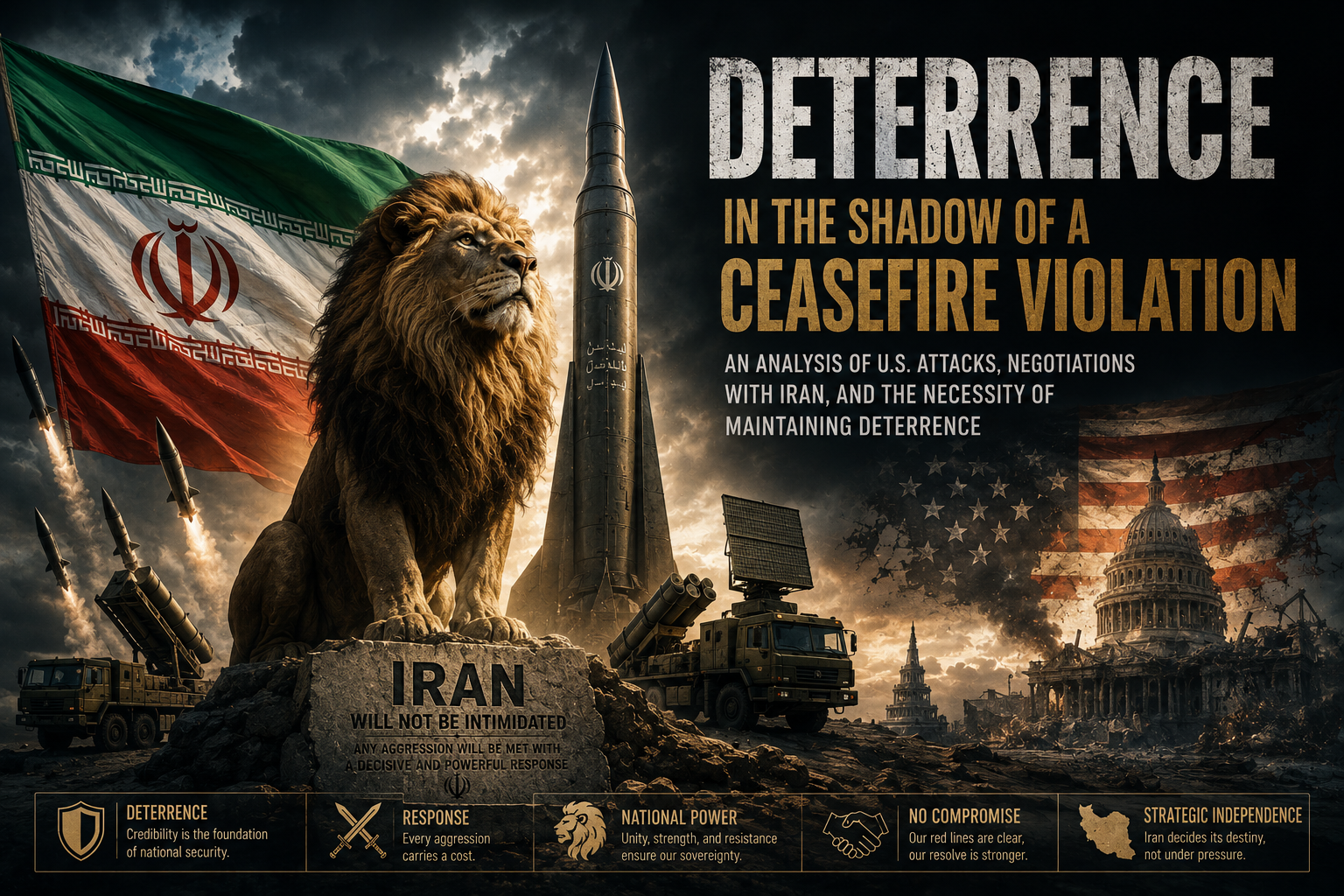
Deterrence in the Shadow of Ceasefire ViolationsThe United States has attacked Iran for the third time during the course of negotiations, thereby violating the ceasefire agreement. This action signifies a transition from a phase of tension management to a phase of testing Iran’s resolve and capabilities. Through this approach, Washington seeks to identify the boundaries of its adversary’s red lines and assess Iran’s willingness to respond to hostile actions. Such probing behavior is based on gradually crossing successive layers of the opponent’s red lines in order to provoke a reaction and determine at what point the adversary will finally respond. If no response is forthcoming, deeper and more consequential layers become the next targets.
This form of aggressive conduct aims to create uncertainty among the decision-makers of the targeted state regarding whether and how to respond to ceasefire violations. Simultaneously, it allows the United States to assess whether the costs associated with breaching the ceasefire remain tolerable. By doing so, Washington attempts to generate divisions among decision-makers, placing the opposing side in a dilemma between accepting damage in order to preserve the ceasefire or accepting the costs of confrontation in order to preserve credibility. If such aggression is met with silence or an inadequate response, the balance of power gradually shifts from equilibrium toward domination by one side.
Power has meaning only when it is accompanied by the demonstrated ability to employ it in practice. Therefore, any effort by the United States to undermine the defensive capabilities or military resolve of the Islamic Republic of Iran must be assessed in terms of its implications for deterrence. Responding to military attacks and ceasefire violations constitutes a fundamental security imperative. In the anarchic international system, national security can only be safeguarded through the demonstrated capacity to retaliate and impose reciprocal costs on an aggressor. If a state fails to respond proportionately—and at a level exceeding the adversary’s attack—to a clear violation of a ceasefire, it effectively erodes the credibility of its deterrent posture. The loss of deterrence credibility represents one of the most dangerous consequences for national security because it sends a clear signal to all hostile actors that the costs of attacking the state are lower than the costs of engaging with it. Such a condition opens the door to future attacks and initiates a chain of escalating aggressions, each building upon the weakness demonstrated in response to the previous one. In effect, red lines are crossed gradually and layer by layer. At this level of tension, what is unfolding extends beyond a limited military confrontation; it becomes a struggle over survival and status within the international system, where silence can be interpreted as acquiescence to the dominance of the opposing side.
It is important to recognize that the collapse of deterrence is not merely a military calculation but also a psychological phenomenon that shapes the perceptions of strategic decision-makers. When an adversary repeatedly violates a ceasefire and launches attacks, it is effectively conducting a test. If Iran’s response does not correspond in scale and intensity to the aggression committed, the concept of cost in the minds of American decision-makers gradually transforms into a perception of opportunity and gain. The adversary concludes that it can cross Iran’s red lines at minimal risk and without severe consequences. This dynamic can produce an escalating cycle of tensions in which each attack serves as a precursor to broader and deeper attacks. Under such circumstances, security is no longer defined by prevention; instead, it becomes a matter of managing the consequences of weakness—arguably the worst possible condition for a deterrence strategy.
Failure to respond to such attacks carries another significant consequence: the weakening of regional alliances. In an international order shaped by power, both state and non-state allies calibrate their level of cooperation and dependence according to the perceived strength of a partner. If an actor remains silent in the face of repeated ceasefire violations and infringements upon its sovereignty, it sends a signal to its allies that alignment with its security strategy may be costly and ineffective. The result can be strategic isolation, a condition in which the state faces mounting pressures not only in the military domain but also across diplomatic and economic arenas.
At the same time, the United States’ failure to uphold the ceasefire may create an opportunity to redefine the regional balance of power. When the traditional norms of diplomacy and ceasefire agreements are violated, Iran may seek to impose new rules through active deterrence. Active deterrence does not necessarily imply entering a full-scale war; rather, it involves demonstrating that any action taken outside established frameworks will generate costs that are difficult to predict and impossible to control. At this critical juncture, the Islamic Republic of Iran faces a choice between preserving a false ceasefire and preserving its security credibility. A ceasefire built upon the acceptance of attacks and the erosion of security merely grants the adversary time and opportunity to prepare for future aggression. Consequently, a response to American attacks should not be interpreted as escalation initiated by Iran. Rather, only by reimposing costs on the aggressor can it be compelled to return to agreed rules and ceasefire commitments. The violation of the ceasefire by the United States is neither an isolated nor a temporary occurrence. To confront this challenge, Iran must utilize all available defensive instruments and deliver a response exceeding the adversary’s expectations in order to restore deterrence credibility. Only through such measures can future waves of aggression be prevented.
The same logic applies to negotiations. Iran must remain vigilant against the Salami Slicing Strategy. Under this approach, an adversary refrains from presenting its maximal demands all at once—knowing that such demands would likely provoke outright rejection—and instead divides its ultimate objective into a series of small, incremental, and seemingly insignificant concessions. By accumulating these minor gains over time, the adversary gradually undermines the overall power structure of its counterpart. The purpose of this tactic is to reduce the sensitivity of decision-makers and normalize small retreats, allowing the target state to move step by step away from its original red lines without recognizing the strategic turning point. By the end of the negotiation process, it finds itself confronted with an imposed reality that effectively reflects the adversary’s original and larger objective in fragmented form.
For this reason, the negotiating team must adopt a holistic view of the negotiation process and assess each seemingly minor concession not as an isolated issue but as a component of a broader strategic puzzle aimed at altering the balance of power. By linking such incremental demands to the country’s existential security interests, negotiators can prevent the negotiating table from becoming an instrument of imposed submission. The acceptance of successive layers of American demands would ultimately result in the erosion of the achievements secured in the post-war environment. Viewed from this perspective, the cumulative acceptance of incremental concessions risks undermining strategic gains that have been achieved at considerable cost.